


Climate change is leading to an increase in extreme weather events, particularly heavy rainfall, which pose significant risks to road traffic. In Europe alone, weather- and climate-related natural disasters caused economic damage amounting to around 500 billion euros.
Spotting and avoiding aquaplaning
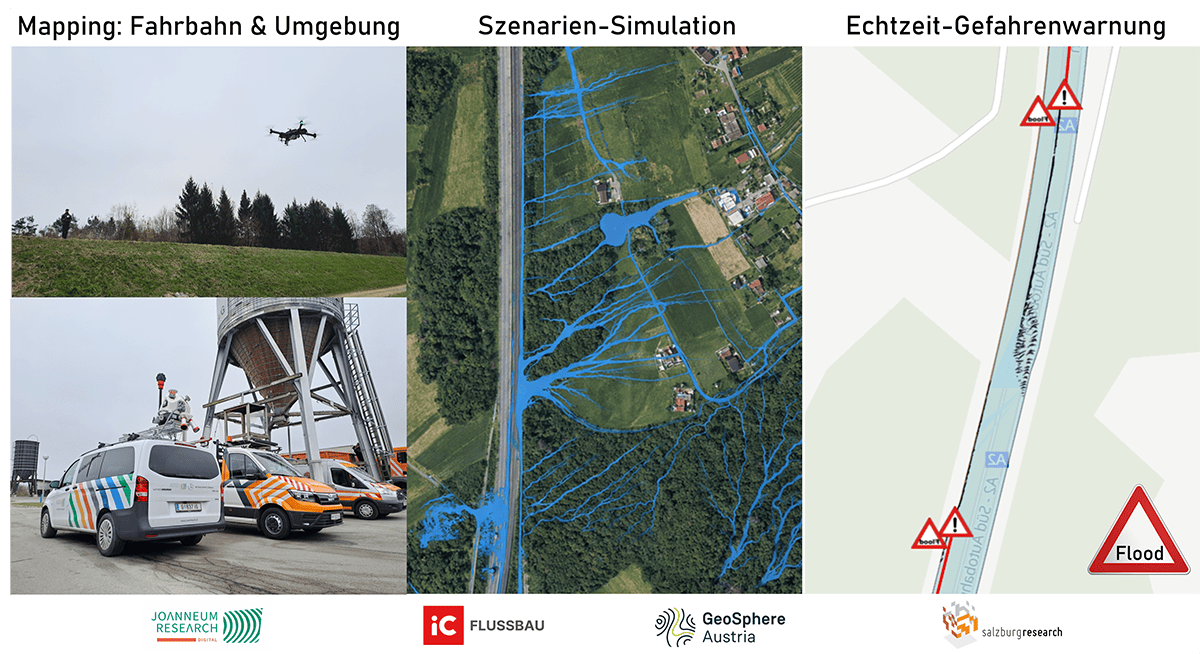
As part of the recently completed FFG project WETSAFE, a team led by Patrick Luley from the DIGITAL Institute developed a system that detects potential hazard spots caused by heavy rain at an early stage. To achieve this, a highly accurate digital twin of the road surface and its surroundings is created; when combined with forecast rainfall levels, this simulates the formation of water films on the road surface and thus predicts the risk of aquaplaning.
“For the first time, we have integrated the simulation of the traffic environment into existing traffic management technologies such as C-ITS (Cooperative Intelligent Transport Systems),” says project manager Luley. These systems enable the exchange of information between vehicles (Vehicle-to-Vehicle, V2V) and between vehicles and the transport infrastructure (Vehicle-to-Infrastructure, V2I) . This allows everyone in vehicles to be informed and warned at an early stage. “Furthermore, road operators can use the simulation to identify potential bottlenecks in road drainage and derive preventive infrastructure measures,” Luley continues.
Given the increasing frequency of heavy rainfall events, which account for over 40 percent of all weather-related natural disasters in Europe, the development of such systems is crucial to improving road safety and minimising economic damage.
The project was supported by Bundesministerium Innovation, Mobilität und Infrastruktur (BMIMI) and ASFINAG.
Partner:
GeoSphere Austria – Bundesanstalt für Geologie, Geophysik, Klimatologie und Meteorologie, flussbau iC GesmbH, Salzburg Research Forschungsgesellschaft m.b.H.