


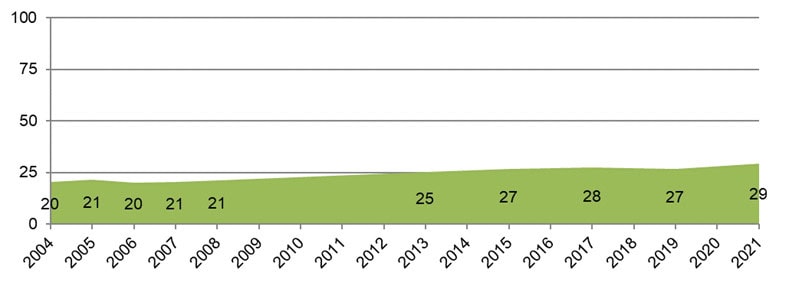
The Equality Survey 2022 zeigt einen Anstieg des Wissenschaftlerinnen-Anteils zwischen 2019 und 2021 von 27% auf 29% in der außeruniversitären naturwissenschaftlich-technischen Forschung. Trotz dieses Fortschritts bestehen nach wie vor deutliche Unterschiede zwischen Frauen und Männern in diesem Forschungssektor.
Partizipation von Wissenschaftlerinnen zwischen 2019 und 2021 gestiegen
The current Equality Survey 2022 was carried out by the Policies Institute on behalf of the Federal Ministry for Climate Protection, Environment, Energy, Mobility, Innovation and Technology (BMK). The results show for the first time how the participation of women and men in non-university scientific and technical research changed between 2019 and 2021, a period characterized by the COVID-19 pandemic. geprägten Zeit, verändert hat. Die Partizipation von Wissenschaftlerinnen hat in diesem Zeitraum zugenommen: rund 29% der Wissenschaftler*innen sind 2021 Frauen – gegenüber 27% im Jahr 2019. Die COVID-19 Pandemie hat sich also nicht negativ auf die Partizipation von Frauen in der außeruniversitären naturwissenschaftlich-technischen research .
Still clear differences between male and female scientists
However, there are still clear differences between female and male scientists: female scientists are much more likely to work part-time, are significantly younger, are less likely to take on management positions and project management and are also overrepresented in the lower income groups. There are also comparatively few women on the boards of non-university scientific and technical research institutions.
At the same time, it can be seen that around a third of research institutions have not yet developed and implemented an equality plan in 2022. But even of those institutions that already have an equality plan, the majority only developed such a plan in 2021 or 2022.
Focus study: Pandemic as a catalyst for new forms of work organisation in research
The exploratory focus study in connection with the 2022 Gender Equality Survey in non-university scientific and technical research was able to show that the pandemic-related switch to working from home and other new forms of work has brought both challenges and enrichments for the everyday working lives of scientists in non-university scientific and technical research.
Through the dissolution of familiar everyday structures both at work and at home, academics with childcare responsibilities in particular experienced an incompatibility of professional work, childcare and housework. This was further exacerbated by the by the ideal image that managers have of scientists, welches davon ausgeht, dass Wissenschaftler*innen sich uneingeschränkt der wissenschaftlichen Arbeit widmen können.
For scientists without supervisory functions, the lack of structure and the extension of working days in the home office into the evening were challenging. In addition, the restrictions on professional and social life for this group of academics created a feeling of isolation.
On the other hand, the changes in working conditions triggered by the pandemic were also viewed positively. The majority of academics appreciate the opportunity to work from home, as the time they have gained as the resulting flexibility in the organisation of working hours, which makes it easier to combine professional work with household and care activities, increases subjective quality of life and efficiency. In the longer term, this can also promote gender equality and general inclusion in science.
You can find the full report on the focus study of the 2022 Gender Equality Survey here.