


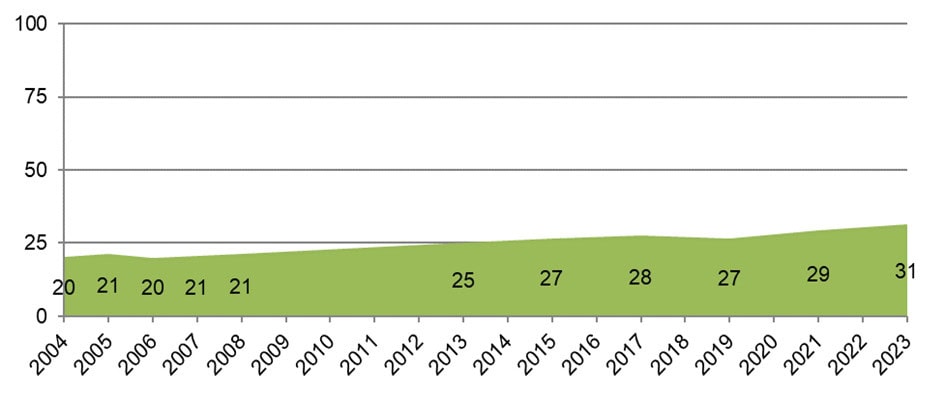
Share of women at record high
With a 31 % share of women in non-university research, the figure for 2023 is higher than ever before. Particularly pleasing: 42% of new hires were women, which underlines the efforts of research institutions to promote gender equality. Progress is also visible in management positions: the Glass Ceiling Index in 2023 fell to 1,8 (2021: 2,0), which indicates better opportunities for advancement. Nevertheless, the proportion of women in management positions remains low at 10 % .
Existing challenges
In addition to the distribution of management positions, other challenges remain: Women are significantly more likely to work part-time (57% compared to 35% of men) and take 72% of family-related leaves of absence. At the same time, women are overrepresented in younger age groups, which makes it more difficult for them to be represented at higher career levels. This in turn is reflected in income inequalities: only 14% of women, but 31% of men earn more than €5,000 gross per month (full-time equivalent).
Data on Publications was also collected for the first time in 2024: Here, too, there are differences in terms of the representation of women, who make up 30% of active publishers, but only 25% of publications. Viewed over a longer period of time, the comparatively small differences accumulate and can reinforce the inequalities between women and men.
Long-term significance of the equality plans
Around 59% of research institutions have now implemented gender equality plans. Initial results indicate that these measures are bringing about positive changes, particularly in the promotion of women to management positions and in the recruitment of young female scientists. The next surveys will show whether the positive trends will continue in the long term.
Flexibilisation of work and career models: Focus study on the implementation of measures in the AUFO
This year, the focal study of the Gender Equality Survey focussed on the implementation of flexible working and career models. Using qualitative interviews, employees from four research institutions were asked about their experiences with flexible working and career models.
Potential for equality is also associated with challenges
It was shown that flexible working and career models have great potential to promote equality and diversity. There are a number of advantages for both employees (including an improved work-life balance) and employers (including an attractive workplace). Nevertheless, the implementation of flexible models is associated with a high level of coordination effort and potential for conflict.
Openness and understanding are basic requirements
The following aspects were identified in the study as key prerequisites for flexible working and career models: Within the organisation, an open corporate culture and the courage and willingness to embrace change are essential. Furthermore, mutual understanding and appreciation for colleagues and their work and private lives are important for the successful implementation of flexible models. Open communication and mutual trust within the team are also beneficial.
Further information and the respective long reports can be found under the following links:
- The entire monitoring report can be found here.
- The full report on the focus study can be found here.
- The factsheet with the most important results can be found here.
- Article on the Gender Equality Survey 2024 on the website of the Federal Ministry for Climate Action, Environment, Energy, Mobility, Innovation and Technology (BMK).