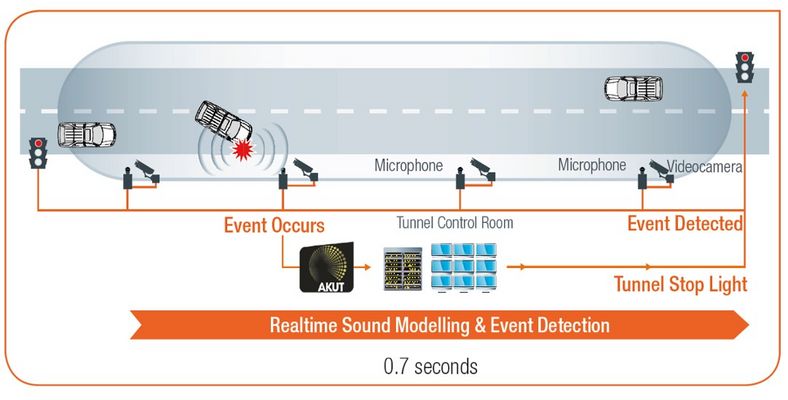
AKUT – Acoustic Tunnel Monitoring increases tunnel safety by continuously analysing the sounds inside the tunnel. By combining intelligent microphones with AI-based signal processing, the system detects critical incidents such as accidents or abnormal events in real time and enables an immediate response. As the tunnel’s “ears”, AKUT helps operators react faster, reduce the risk of secondary incidents, and protect both road users and infrastructure.
How are critical incidents detected?
Traffic inside a tunnel produces a characteristic soundscape — a specific mix of engine, rolling, and airflow noise. Microphones installed throughout the tunnel monitor this acoustic environment continuously. In addition to normal traffic noise, they capture acoustic anomalies. AI-based acoustic detectors analyse the signals in real time and classify them into predefined sound categories. Accidents and other critical incidents are typically accompanied by clearly distinguishable sounds — and importantly, these sounds occur at the exact moment the incident happens, not with a delay. This is why they can be detected immediately.
Why is acoustic detection so fast?
The key advantage of acoustic detection is that it reacts directly to the triggering event. AKUT responds to the sound of the incident itself — for example, the impulse noise generated by a collision. As a result, an alarm can be triggered in the traffic management centre within around one second of the incident.
Other safety systems often detect incidents indirectly, for example by recognising slow-moving vehicles, congestion, smoke, or abnormal traffic patterns. These indicators typically appear only after a certain delay, which leads to longer response times.
What actions can be initiated immediately?
Because incidents are detected instantly, safety measures can be activated without delay. For example, AKUT can:
trigger an alarm in the tunnel control room
automatically display the relevant CCTV feed of the affected tunnel section on a central screen
This provides the tunnel operator with an immediate, real-time overview of the situation. Valuable time is saved — both for initiating first response measures and for warning approaching drivers early, helping to prevent secondary accidents.
Features
Detection of incidents within 1 second
Localisation of incidents by assignment to nearest microphone
Alarm in the tunnel control room with category, event and camera image
Detection and localization of people through their voices/shouts
Live streaming of sounds and voices from the tunnel
Ring buffer for all microphone signals
More than 2.600 microphones
are currently in tunnels
in 24/7 operation
Schematic Diagram
Microphones are installed in the tunnel at intervals of approx. 100 m.“. AKUT can be installed as a fully self-contained system or integrated with other safety systems. For example, if a video system is installed, it is advantageous to locate the microphones at the same positions as the video cameras, as this allows savings in cabling, optical fiber infrastructure, and power supply.