


Space is no longer simply a domain for scientific exploration or geopolitical prestige projects. In today’s world, it is a highly relevant security arena. Satellite communication, Earth observation, and navigation systems form the backbone of critical infrastructure – in both civilian and military contexts. However, increased complexity and connectivity brings more risks.
In 1957, the Soviet Union launched Sputnik 1, the world’s first satellite, marking a historic milestone in the Cold War. The USA followed in 1962 with Telstar 1, the first operational communication satellite. In the meantime, space technology has advanced rapidly, evolving from a handful of geostationary satellites to mega-constellations of thousands of low Earth orbit small satellites. To put it in numbers: in 1970, a few hundred satellites were operational; by 2010, this number had risen to around 15,000. And as of early 2025, there are nearly 40,000 active objects orbiting Earth, with platforms like sky.rogue.space providing real-time visualisation of their positions and orbits.
Orbital infrastructure
Satellite services such as skyDSL (Eutelsat) or Starlink (SpaceX) provide continent-wide internet access, including in remote or crisis-affected regions. This creates opportunities while at the same time fueling increased demand for information security, protection against interception and communication sovereignty. In disaster scenarios or conflict zones, satellite-based communication can be critical for emergency response and coordination. However, targeted disruptions or attacks on satellites – through threats such as “killer satellites” – are now seen as realistic scenarios. The distinction between civilian and military space applications is also becoming increasingly blurred.
Cyberthreats from space
As reliance on satellite services grows, so does vulnerability to cyberattacks targeting both satellites and their ground infrastructure. On 24 February 2022, an attack on Viasat’s KA-SAT satellite network showed just how vulnerable even the most modern systems can be: Ukrainian military communications were interrupted and around 30,000 modems across Europe affected, including control systems for wind turbines in Germany (2022 Viasat Incident Report). Incidents like these highlight the critical need for robust cyberdefence strategies in space. Threats range from GPS spoofing and jamming to targeted hacking attempts on satellites or ground control stations.
JOANNEUM RESEARCH Security research with a space dimension
JOANNEUM RESEARCH has been actively engaged in satellite-based communication and navigation solutions since 1978, initially as the Institute for Applied Systems Technology. Its focus includes using higher frequency bands, optimising modulation and coding, integrating artificial intelligence into signal processing and experimental validation through real satellite connections. Reconnaissance tasks with high security significance are supported by existing satellite systems such as the EU’s Sentinel satellites and smaller CubeSats. JOANNEUM RESEARCH is developing an AI-based service concept for military imagery intelligence (IMINT) the EDF’s IntSen² project. The goal is to facilitate automated, continuous monitoring of large areas using high-resolution Sentinel image data for efficient detection and analysis of critical objects.
Notable projects
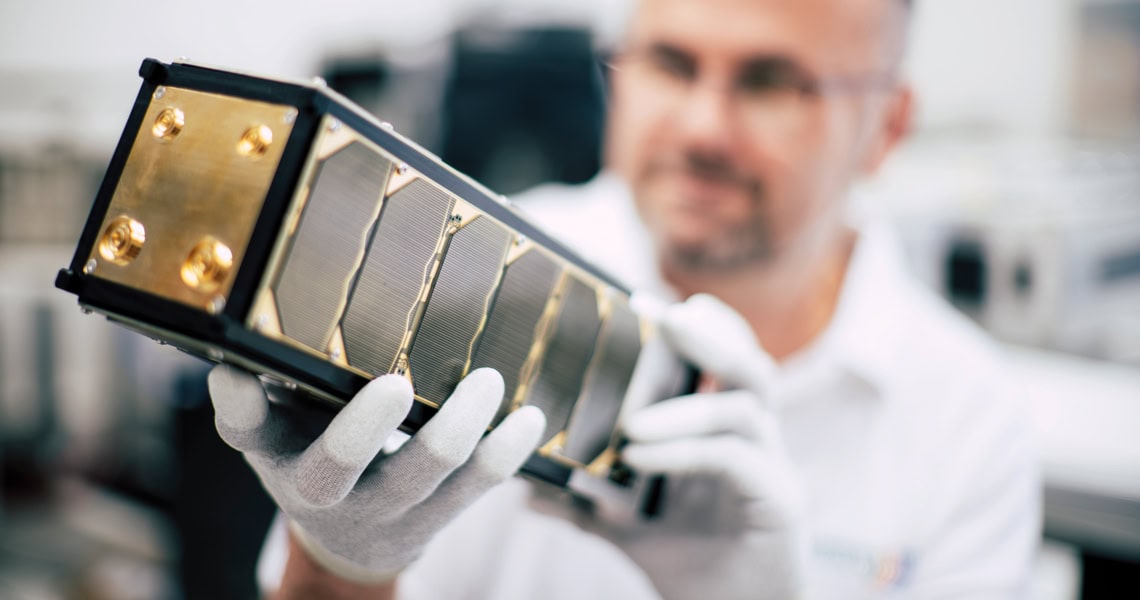
Notable projects include Alphasat Q/V band at Graz’s Hilmwarte observatory, the minisatellite W-Cube, and mobile satellite communication systems. Security is increasingly the focus these days – as evident through participation in projects like Austria’s KIRAS security research programme. Demand for data transmission capacity is growing all the time, with research worldwide focusing on new data highways using higher frequencies. DIGITAL is currently evaluating satellite signals at 75 GHz received from a CubeSat at an altitude of 500km. The increasing commercialisation of space presents both challenges and opportunities for the European space industry. JOANNEUM RESEARCH positions itself as a bridge between science, industry, and public institutions to actively shape technological progress in this field. Space is no longer an isolated domain – it is an integral part of security for critical infrastructure. For Europe and Austria, this means technological sovereignty, reliable partnerships, and innovation-driven research – all of which are essential to reduce geopolitical dependencies and enhance resilience against modern threats.
The IRIS² Project
To underpin Europe’s technological independence, the EU launched the IRIS² (Infrastructure for Resilience, Interconnectivity and Security by Satellite) programme. This planned megaconstellation of approximately 300 satellites in multi-orbit configuration aims to serve both civilian and military purposes, providing resilient communication channels for authorities, emergency services, and critical infrastructure, independent of non-European providers.
By Elke Zenz