


A team from ROBOTICS explored ways of conveying complex content about working with robotic arms in a playful, efficient, and easily understandable way—in other words, learning in extended reality (XR). This saves time and money. Robotic arms – also known as manipulators – are now an indispensable feature of many industries. They can be found performing welding, assembly and painting tasks in automotive manufacturing, populating circuit boards in electronics production, and picking and packing goods in logistics. They are also used in food processing, pharmaceuticals, and recycling – anywhere that involves precision, repetition or physically demanding operations. As a result, workers in these sectors need continuous upskilling to ensure that they are able to work safely and effectively alongside their new mechanical colleagues. The fundamentals of robotic arms – their structure, movement and kinematics – can be hard to compute for humans.
EU project
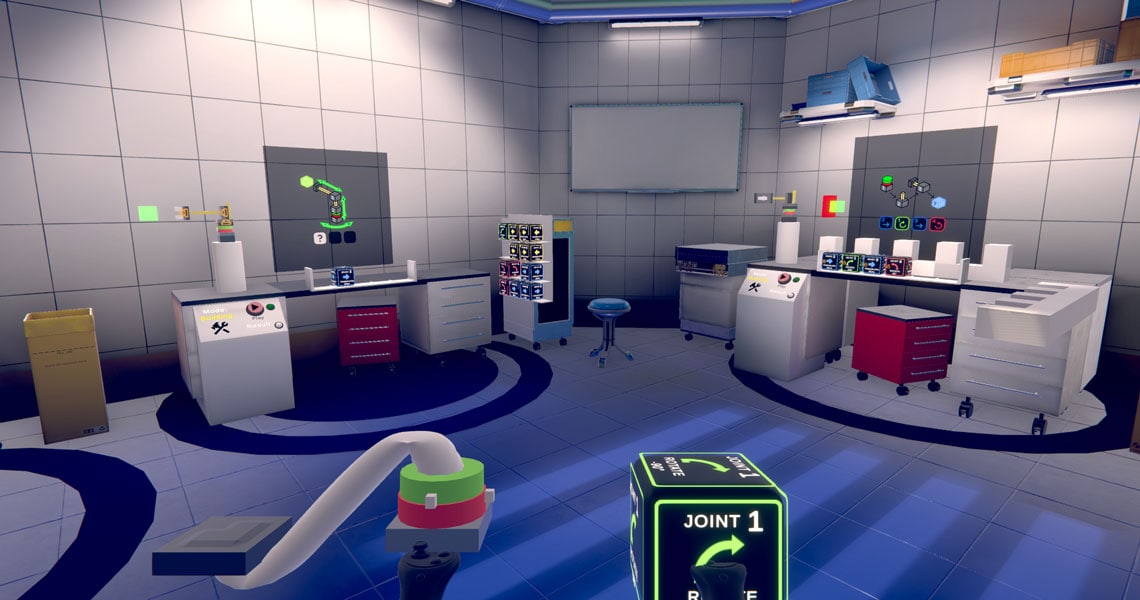
In an EU-funded project dubbed MANIPULAY XR, Bernhard Reiterer and a team from ROBOTICS in Klagenfurt joined forces with design and technology studio POLYCULAR to lower this particular barrier to entry. Built on the MASTER XR platform, the project delivers an intuitive virtual reality environment that lets users build and program robotic arms. XR is an umbrella term for a number of immersive technologies, including virtual reality (VR), augmented reality (AR) and mixed reality (MR). All of these tools help to bring digital content to life within real or virtual settings. In the case of MANIPULAY XR, the power of XR is harnessed as an interactive channel for communicating technical content relating to robotic arms.
Learning in extended reality
Bernhard Reiterer explains how it works: "Everything revolves around interactive puzzle-based learning sequences. Learners combine basic components – joints, links, and grippers – to solve predefined challenges, such as generating collision-free waypoint sequences. Programming centres on a block-based interface, where different cubes represent the movements of individual joints. A virtual 3D printer even allows users to create their own programming elements. Through repeated adjustments to both the design of the robot and the program itself, users gain intuitive insights into kinematics and control." A conscious decision was taken to give the system an open and modular design. Besides offering pre-designed learning paths, MANIPULAY XR also supports the development of custom task formats. "Our project provides ready-made learning paths as examples and gives educators the tools they need to design their own puzzles – based on various scenarios such as a real-world robot model or one of the kinematic systems that is outlined in the literature," Reiterer continues. The platform also facilitates the flexible integration of additional content such as text, video and audio guides.
by Elke Zenz
More
- Project MANIPULAY XR
- JOANNEUM RESEARCH ROBOTICS
- POLYCULAR
- MASTER: Boosting the Future of Industrial Training with XR and Robotics
- YouTube-Video
Co-funded by the European Union. Views and opinions expressed are however those of the author(s) only and do not necessarily reflect those of the European Union. Neither the European Union nor the granting authority can be held responsible for them.