


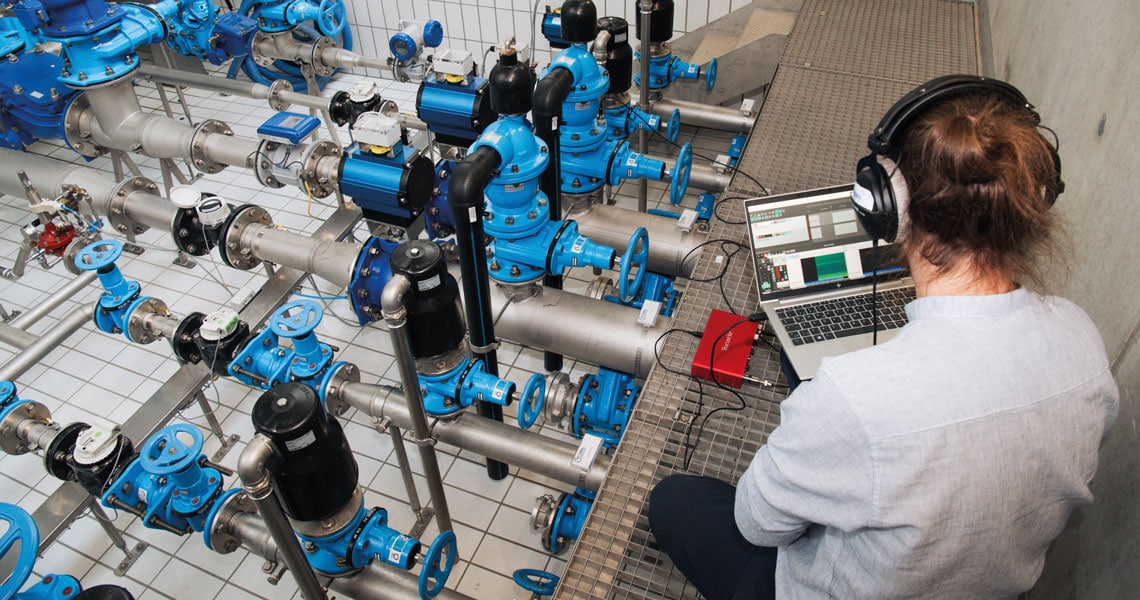
We are facing major challenges when it comes to water and water supply. It is not only climate change that is threatening this commodity that we almost take for granted, but also the increasing pace of life in the digital world that is consuming vast quantities of this precious resource. Researchers at DIGITAL are working together with partners from science and the water industry to solve part of the problem. Stefan Grebien from the Intelligent Acoustic Solutions research group is coordinating the KI-WAZU project. The aim is to improve the management of water supplies in the future. ‘We are developing an acoustic and visual real-time monitoring system for the relevant parts of a water treatment plant and pump stations together with the Intelligent Vision Applications research group. With 24/7 monitoring on an acoustic and visual basis - i.e. with structure-borne sound sensors, cameras and anomaly detectors - it is possible to recognise faults immediately and anomalies at an early stage. This means that repairs can be initiated before a system component actually fails, for example by procuring spare parts,’ explains acoustics specialist Grebien.
AI creates forecasts
The forecast is made possible by a well-trained AI. By interpreting the acoustic and visual signals, it learns to warn the operators of actual damage in good time. However, this is only one aspect of the future-oriented KI-WAZU project. Due to climatic changes such as heavy rainfall, dry periods and the associated new consumer behaviour, it has become necessary to create new forecasting models for the availability of water resources. This is where project partner JR-Aqua-ConSol comes into play. Hans Kupfersberger has been working with groundwater models for many years and explains: ‘Based on groundwater level measurement data in observation wells, weather forecasts and water consumption forecasts, we can calculate future water availability and thus make recommendations for the management of water suppliers.’ The forecasting models are made available to water suppliers by DATAVIEW using innovative visualisations. Franz Zeilinger from DATAVIEW comments: ‘The forecasting models combined with the AI-based monitoring system open up completely new possibilities for water management. The results of the AI methods are presented as suggestions for action, including impact information. Control, including over these new capabilities, remains with the supplier.’
Groundwater problems in Europe
The European Environment Agency (EEA) warns that groundwater supplies are being depleted in several countries due to overuse and climate change. Southern regions of Europe are increasingly affected by water scarcity, while more northern regions are experiencing more frequent flooding. Adapting to these changing conditions requires comprehensive measures such as reducing leakages and reusing water. Spain provides a particularly drastic example of water scarcity. There, large data centres are responsible for considerable water consumption, which puts further pressure on already scarce water resources. The water consumption of these centres can amount to up to 600 million litres per year in some regions, which corresponds to the consumption of around 13,000 households (DER STANDARD). These developments emphasise the urgency of innovative approaches such as AI-supported water management in order to secure the water supply in Europe in the long term. Using structure-borne sound sensors, cameras and anomaly detectors, faults in water treatment plants can be recognised early enough to prevent major damage.
Partner:
DATAVIEW, JR-AquaCon-Sol and SETEC. The water board Leibnitzerfeld Süd, the water board Südliches Burgenland, the water board Unteres Lafnitztal and the municipality of Gmünd are involved as consumers.
More: Multimodal detection of noise offenders in road traffic
The project KI-WAZU was awarded with the Wasserland-Preis of Styria in the ‘Water projects of the future’ category.