


FIRE!
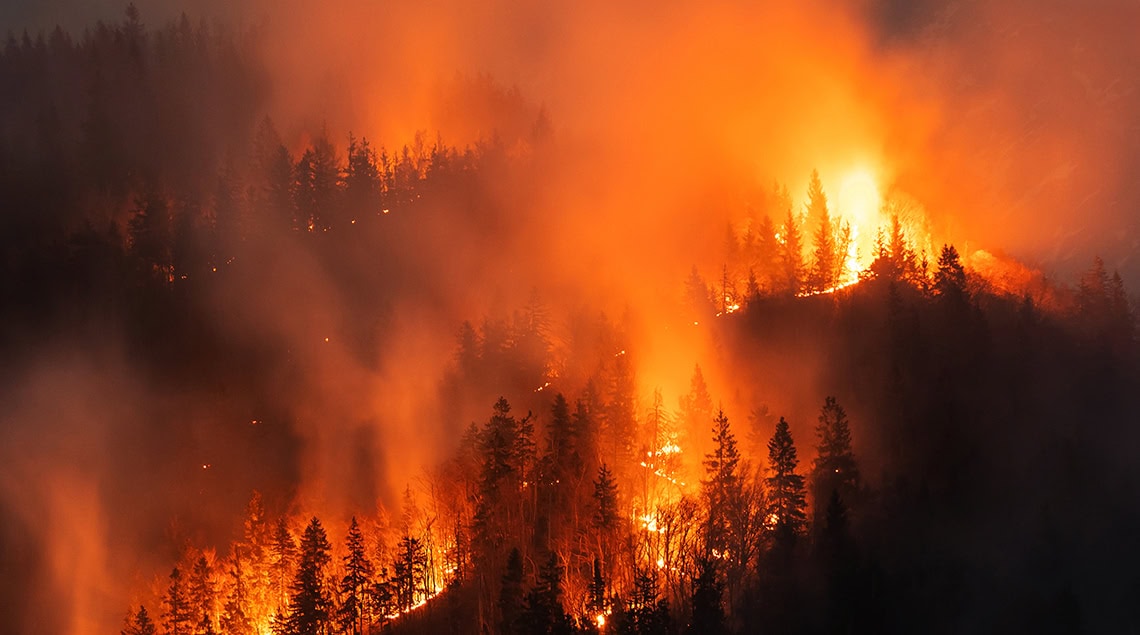
Forest fires are on the rise worldwide and cause enormous economic and ecological damage every year. In Europe alone, up to 500,000 hectares of forest fall victim to the flames every year. Countless forest fires are currently raging in Canada, and wildfires have broken out in Croatia in recent days. And in the USA, the forest fires in Los Angeles in January 2025 destroyed around 160 square kilometres (16,000 hectares) of land, including the Palisades fire covering around 69 square kilometres and the Eaton fire covering around 42 square kilometres. In total, more than 16,200 buildings were destroyed or damaged. In view of this dramatic development, intensive research is being conducted into innovative technologies to support emergency services more efficiently. JOANNEUM RESEARCH is working on a promising approach – namely the use of AI-based robotics.
Im KIRAS-Projekt KI-SecAssist entwickelte Markus Bergen mit seinem Team Assistenzsysteme für Einsatzkräfte. Unmanned aerial vehicles (UAVs) and ground vehicles (UGVs) equipped with multi-sensors are used to generate a situation picture in near real time. These are multitaskers, so to speak, because these AI-supported systems can detect fires at an early stage, map affected areas and assist with evacuation.
Markus Bergen, Senior Researcher at DIGITAL, explains: ‘Autonomous drones provide us with real-time information about injured persons, the fire situation, and temperature and gas values. This gives emergency services a comprehensive picture of the situation, enabling them to work in a targeted and efficient manner.’
What makes this particularly interesting is the interaction between drones and unmanned ground vehicles, which can independently enter dangerous areas. These could deliver supplies or evacuate people from the danger zone. ‘Autonomous vehicles could significantly increase evacuation capacity and reduce the risk to emergency services,’ Bergen continues.
Networking and collaborative task management
The researchers are also working on a system that prioritises tasks and objectives and coordinates the autonomous systems optimally. ‘This cooperative task management is based on the use of autonomous aircraft and vehicles. For example, autonomous drones can detect fires, transmit the relevant data to the operations centre and then send autonomous vehicles to the scene to rescue injured people,’ explains Bergen.
This technology enables faster decision-making, which significantly increases the effectiveness of emergency services. ‘The interaction between humans and machines is optimised so that dangers can be better assessed and combated more quickly,’ emphasises Bergen.
JOANNEUM RESEARCH is working on the further development of autonomous systems in several international projects. One example is a project funded by the European Defence Fund, in which UAVs and UGVs are being tested for the evacuation of injured persons. The autonomous systems should be able to independently detect danger zones, identify injured persons and transport them safely.
Thanks to these innovative developments, fighting forest fires and similar disasters could become safer and more efficient in the future. The combination of AI, sensor technology and autonomous vehicles can make a decisive contribution to protecting people and nature.
The AI-SecAssist project was funded and financed as part of the KIRAS programme by the Federal Ministry of Finance and implemented by the Austrian Research Promotion Agency.
Markus Bergen ist Spezialist für photogrammetrische Bildverarbeitung, Geoinformationsdienste und Multi-Sensor-Systeme und seit Oktober 2023 bei DIGITAL in der Forschungsgruppe Fernerkundung und Geoinformation. He is currently primarily involved in the field of security and defence, providing comprehensive situational awareness information through the use of mobile platforms (UxVs), portable sensor technology, geodata analysis and sensor fusion.