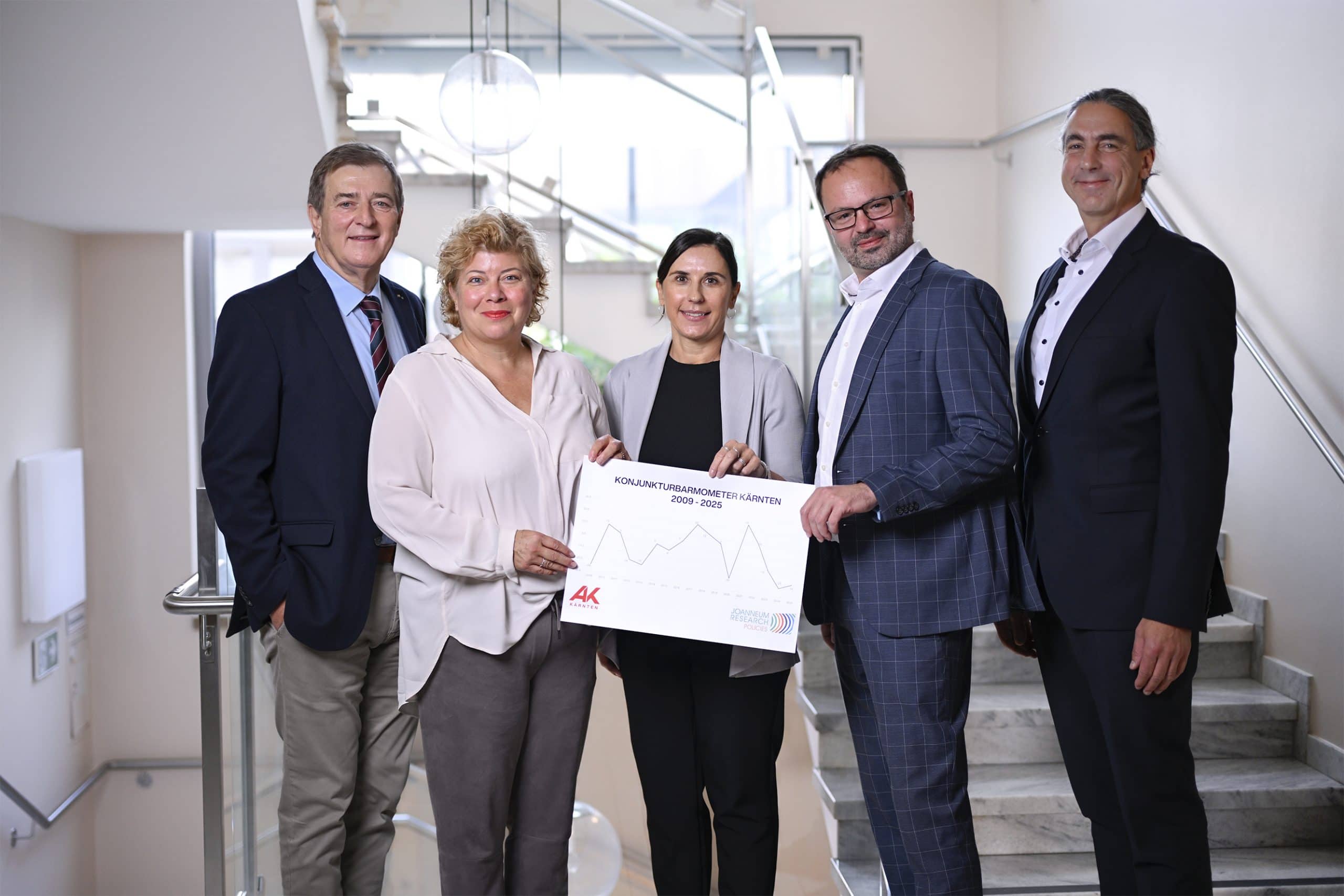


Economic survey by the Carinthian Chamber of Labour: After two years of recession, Austria – and Carinthia with it – is facing a slight economic recovery. For the latest study by the POLICIES Institute on behalf of the Carinthian Chamber of Labour, more than 200 companies with around 62,000 employees were surveyed. Carinthian companies are struggling with the same structural problems as the Austrian economy as a whole – and energy-intensive industries are also severely affected. ‘After a two-year recession, we expect the Austrian economy to grow slightly by 0.3 per cent in 2025,’ says study author Eric Kirschner. ‘However, the overall conditions remain difficult. High energy prices, rising labour costs, weak export markets and a generally subdued willingness to invest are weighing on the economy.’
Longest recession of the post-war period
The domestic economy has not fully recovered since the slump caused by the pandemic. According to WIFO, Austria is in its longest post-war recession, with a decline of 1 per cent in both 2023 and 2024. A slight turnaround is not expected until 2025, with gross domestic product set to rise by 1.1 per cent in 2026.
‘However, there is no sign of genuine growth momentum,’ said Kirschner. Economic uncertainty remains high – partly due to US trade policy and weak global demand.
Labour costs as a locational disadvantage
High labour costs are particularly problematic. In Austria, they are around 20 per cent above the eurozone average and rose again at an above-average rate in the second quarter of 2025. This puts pressure on export-oriented companies in particular.
‘Labour costs are a significant disadvantage for the location,’ says Kirschner. Examples such as the job cuts at fibre manufacturer Lenzing show that companies are increasingly moving abroad.
Competition from China is also having a noticeable impact: exports in the automotive and mechanical engineering industries are falling, particularly to the United States (–14.4 per cent) and Germany (–1.1 per cent). Carinthia recorded a decline of over 6 per cent in trade with Germany in the first half of 2025.
Construction and industry particularly affected
The mood in Carinthia's economy remains subdued. The economic barometer remains in negative territory, with the situation being weakest in construction, trade and technology production. The information and communication sector, on the other hand, is showing slight signs of stabilisation.
Despite the gloomy picture, the labour market remains relatively robust: many companies are still looking for staff, and planned job cuts are down on last year.
Skilled labour shortage remains persistent
More than half of the companies surveyed complain about a persistent shortage of skilled workers – despite economic uncertainties. The shortage particularly affects industry, construction and technical services. Added to this are demographic change and the so-called ‘hoarding’ of employees, i.e. retaining staff despite a weaker order situation.
Investments declining but stable
According to the survey, investment in Carinthia is continuing, albeit at a more cautious pace than in previous years. Construction investment (50%) and machinery and equipment (38%) remain the most important items. One third of companies are investing in climate and environmental protection measures.
According to the study, domestic bureaucracy and rising costs are having a negative impact, which could lead to new investments being shifted abroad. Replacement investments predominate, indicating a certain degree of caution in location development.
Artificial intelligence still plays a minor role
Fragen zu KI und Digitalisierung zeigen, dass diese Themen in Kärntner Unternehmen derzeit noch wenig Relevanz haben. Zwei Drittel der Befragten sehen künstliche Intelligenz als untergeordneten Faktor in ihrer Unternehmensstrategie. Positiv ist jedoch, dass 77 Prozent keinen steigenden Leistungsdruck durch den Einsatz digitaler Technologien befürchten.
No swan song for the economy
Despite ongoing uncertainty, researchers see no reason for pessimism. Many companies continue to train apprentices, seek staff and invest in new equipment.
‘It is too early to write off domestic production,’ the study concludes. However, structural policy measures are needed to ensure Carinthia's competitiveness: lower taxes and levies, simpler regulations, reforms in the education system and a reduction in energy prices. Only through targeted investment in research and development can the location be strengthened in the long term.