


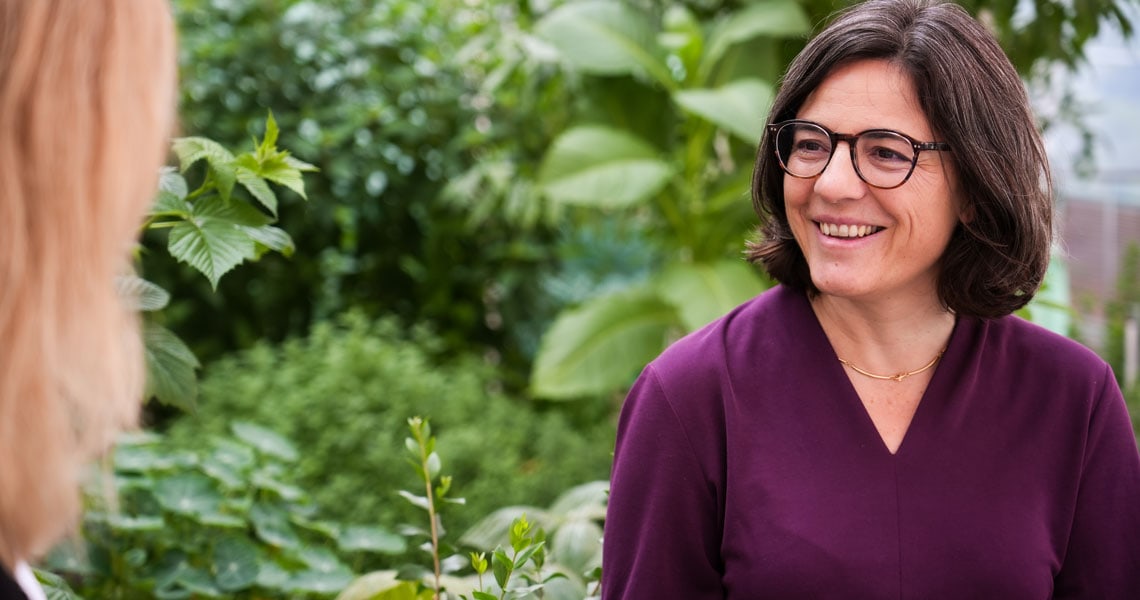
Everything we do and every product that comes onto the market has an effect on our surroundings and the environment. The impacts of products and services can be determined using life cycle assessment (LCA). To find out more, we spoke to Sara Carniello from the LIFE Institute.
What is life cycle assessment?
Carniello: LCA is a method that enables us to evaluate the Impacts of a product or service over the entire life cycle – from raw material extraction right through to disposal or recycling. However, the added value generated goes beyond environmental aspects, because it can also take social and economic dimensions into account. This enables us to highlight potential innovations and risks along the supply chain. The analysis pinpoints "hot spots" or levers that can be exploited in order to improve products. But it’s important to make use of them during the product development phase.
What does JOANNEUM RESEARCH use LCA for?
Carniello: Firstly, in Research projects – it’s a tool for assessing different technological Options and steering technological development in the desired direction. Secondly, we act as consultants for companies that want to understand, compare or optimise the impacts of their products. The Benefit we offer is that – thanks to our experience with R&D projects – we can evaluate technologies as early as in the development phase. Our team is made up of technicians, sociologists and economists who can carry out effective Analysis of complex questions while also considering all three key dimensions: environmental, social and economic.
Are these measures always expensive?
Carniello: Not necessarily. The focus is often on designing more efficient processes or on staff deployment; it doesn’t have to revolve around major investments. Initially, there are costs associated with building new facilities or energy supply systems, but in the long term they deliver savings, planning certainty and independence. Investments in sustainable innovations are usually made on a Long term basis, and they Need to be aligned with the company’s strategy.
Can you give us some examples of businesses you’re currently cooperating with?
Carniello: We’re supporting Ino GmbH in the development of a new coating process that was designed in collaboration with the MATERIALS Institute. We identified all of the key hot spots. Another of our projects involves comparing an Austrian start-up’s hydrogen production process with conventional processes. And for Rosenbauer we analysed the environmental Impacts of electric and diesel fire engines, as part of a technology partnership with the IEA, the International Energy Agency.
We’ve seen some backsliding on environmental measures at the global level, and also in the EU. What effect will that have?
Carniello: Obviously it’s detrimental for the environment. And ultimately for the economy, too, because the debates about environmental regulations draw attention away from the true cause of the problems. But many companies are continuing to take action because they recognise the benefits for their Innovation capabilities and Business models. Environmental Standards are often perceived as an inconvenience because of the negative connotations – they’re seen as burdensome and expensive. But they really can promote innovation: by cutting resource consumption, boosting efficiency and creating more resilient supply chains.
You worked in technology development in the private sector for many years. Why did you make the switch to sustainability assessment at JOANNEUM RESEARCH?
Carniello: When you work for a company, you’re focused on a particular product or sector. Here, we cover a much broader spectrum: a wide range of topics, technological, economic and regulatory issues, and cooperation with a variety of different stakeholders. This creates synergies, and ideas can be transferred from one sector to another – for me, that’s what makes the work more fascinating and rewarding.
Interview: Petra Mravlak