


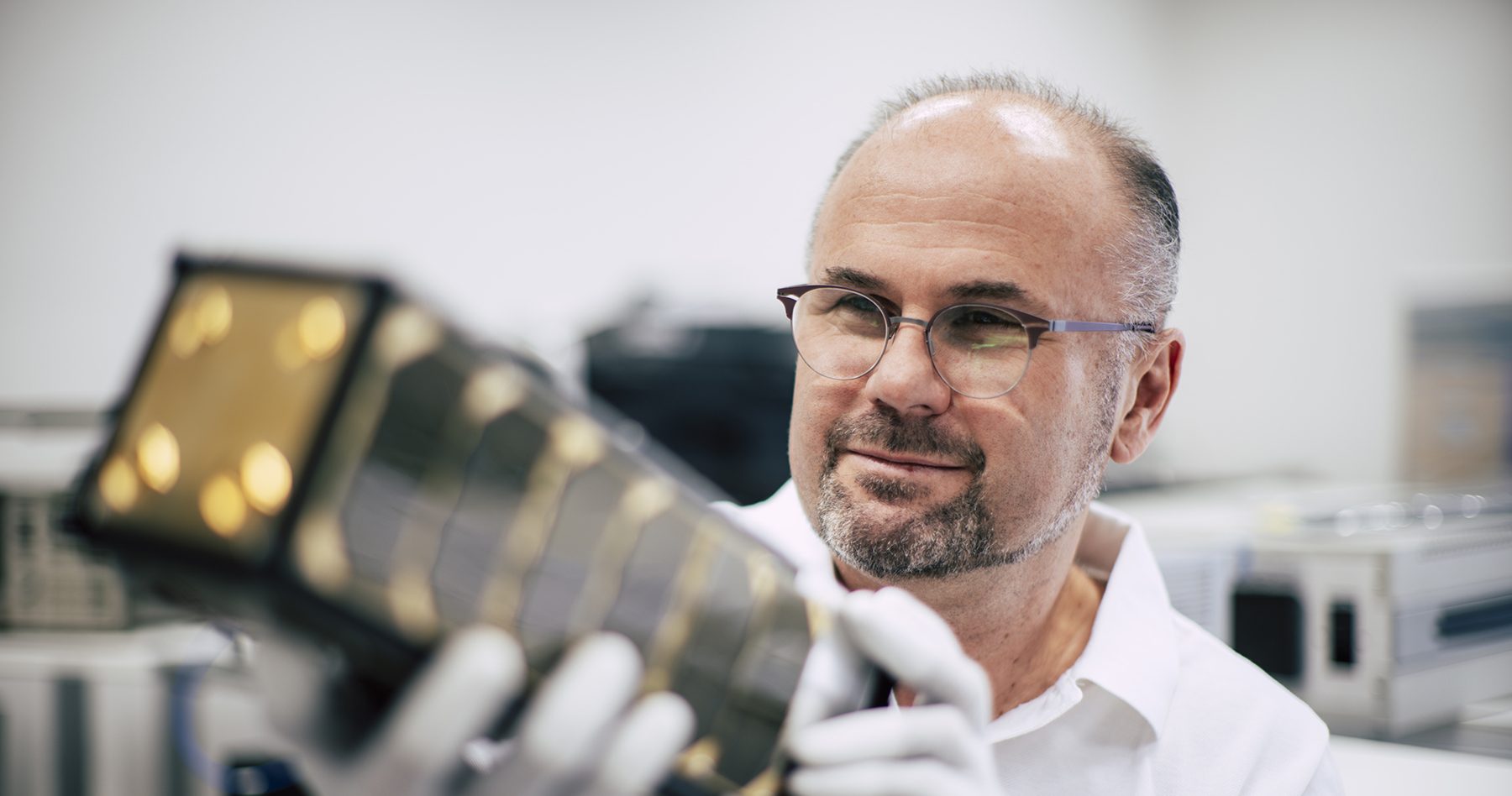
The international project team eagerly awaited the CubeSat's entry into Earth's atmosphere. The W-Cube mission in low Earth orbit (LEO), launched in summer 2021 on the initiative of the European Space Agency (ESA), has come to a successful conclusion. The research team was able to demonstrate that high frequencies in the W band (75 GHz) and Q band (37.5 GHz) work in practice as feeder links for satellite internet.These frequencies enable significantly higher data rates than the frequency ranges used today (e.g. Ka/Ku band). This is crucial for the next generation of global broadband satellite systems. The successful test thus marks a technological milestone for future high-performance networks in space.
The pioneering achievement of the mission was to enable the successful transmission of a 75 GHz beacon with double circular polarisation from space and the reception of the signal at the ground station in Graz on the roof of JOANNEUM RESEARCH DIGITAL. This enabled the researchers to carry out extensive statistical evaluations over the four years of the project. Another ground station was put into operation at VTT in Espoo, Finland, and ESA ESTEC (Noordwijk, NL) carried out short-term measurements. The results were published in several journals and provide significant support for the design, construction and operation of satellite systems in these frequency ranges.
The mission ended on 1 October, and the CubeSat completely burned up in the atmosphere upon re-entry from low Earth orbit (LEO). This means that no debris will reach the Earth's surface.
The next step will be to extend this pioneering work to geostationary Earth orbit (GEO). Measuring a W-band beacon from GEO will enable continuous, round-the-clock observation and pave the way for the development of robust, high-capacity satellite broadband systems.
‘With W-Cube, we have broken new ground because we were able to demonstrate the use of W-band frequencies from space for the first time,’ says Arturo Martin Polegre, technical manager of the project at ESA. "With the successful completion of this mission, the knowledge gained will be directly incorporated into the design of future satellite communication systems, ensuring that Europe remains at the forefront of innovation in space. "
JOANNEUM RESEARCH project manager Michael Schmidt emphasised the joint effort behind this success: ‘This project has set new standards in the development of new high-frequency components, the satellite and the ground station. It was an exciting experience for the team to receive and analyse signals in the W band for the first time worldwide. This success represents an important step for innovation and progress in this field.’
JOANNEUM RESEARCH Managing Director Heinz Mayer confirms: ‘This technological achievement demonstrates the outstanding expertise and commitment of all partners involved and is the result of many years of successful cooperation with ESA and our partners. Congratulations to the project team!’
FFG Managing Director Karin Tausz congratulates Joanneum Research, ESA and the international project team on the success of this pioneering mission: ‘Once again, it has been demonstrated that the perfect interplay between innovative space players, the FFG Space Agency and ESA enables results that are world-leading.’
The team would like to thank the national ESA delegations from Austria, Finland, Germany and Portugal for their support of this historic mission.
The mission was carried out in collaboration with a consortium of leading European institutions and companies:
- VTT – Payload development
- Kuva Space – Satellite bus and satellite operation
- Fraunhofer IAF – Q- and W-Band-Front-End-Module
- University of Stuttgart – Link budget and channel analysis
- Luis Cupido Technologies (LCT) – Ground stations (antenna, tracking and step-down converter)
- JOANNEUM RESEARCH DIGITAL – Project management, beacon receivers and data processing