


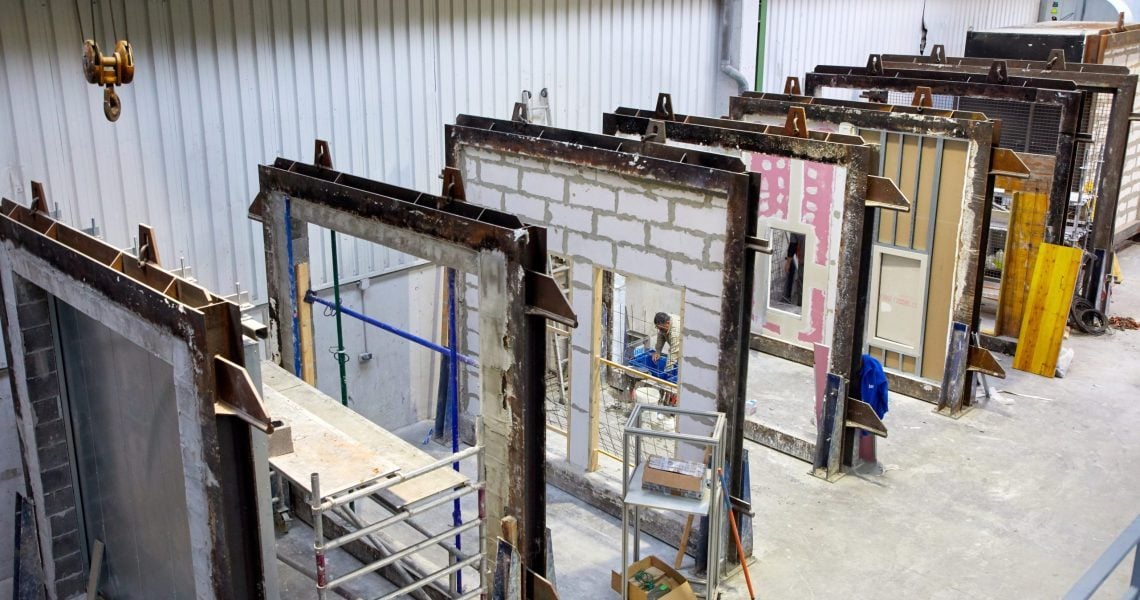
The energy-efficient renovation of buildings is seen as a key driver of climate action – yet progress in Europe has so far been too slow. In the EU-funded research project RENOMIZE, a research team aims to demonstrate how renovations can be carried out much more quickly, efficiently and with less disruption to residents. Thirteen partners from nine European countries are involved. Overall coordination is handled by the ROBOTICS Institute at JOANNEUM RESEARCH, whilst the LIFE Institute analyses the environmental and economic impacts of the new technologies.
Buildings account for around 40 per cent of energy consumption in the European Union, whilst the annual renovation rate currently stands at only around 1 per cent. To achieve the targets of the European Green Deal, this rate must increase significantly. In the RENOMIZE project, researchers are therefore focusing on industrial prefabrication, automation and digital planning to carry out renovations more efficiently. RENOMIZE setzen Forschende daher auf industrielle Vorfertigung, Automatisierung und digitale Planung, um Renovierungen effizienter umzusetzen.
Renovation and Refurbishment Using Robotics
The project focuses on what is known as ‘serial refurbishment’. In this process, façade elements are prefabricated in factories and then assembled on site. This allows many of the work stages to be shifted from the construction site to industrial production processes.
“Our aim is to move as many stages of the renovation process as possible from the construction site to the factory, thereby significantly speeding up the process,” says Christian Oswald, Director of the ROBOTICS Institute and project coordinator. “With optimised manufacturing processes and robotic assembly systems, we aim to be able to carry out renovations much more quickly in future.”
ROBOTICS is responsible for the overall coordination of the project within the RENOMIZE consortium. In terms of content, the institute is primarily working on optimising off-site manufacturing and automating assembly on the construction site. This also includes the development of a robotic end-effector capable of automatically installing anchors for the façade elements.
The prefabricated panels incorporate several functions at once – such as insulation, ventilation, parts of the building services, and in some cases photovoltaic systems. This helps to avoid extensive work inside the building and reduces the use of fossil fuel-based heating systems.
The impact of renovation on the environment, costs and those affected
Whilst ROBOTICS develops the technical solutions, JOANNEUM RESEARCH LIFE analyses their impacts. The institute is responsible for impact assessment, life cycle assessments (LCA), performance assessment and validation within the project. “A key advantage of phased renovation is that it significantly reduces construction time and causes less disruption to residents,” explains Andreas Türk, head of the research group for International Climate Policy and Economics at LIFE. “If a renovation takes not six months but perhaps just ten days, that makes a huge difference to the people in the building.”
As part of the project, the LIFE team is investigating both the environmental and economic impacts of the new technologies. This includes measuring environmental parameters such as air quality and noise levels, as well as conducting surveys of users before and after the renovation. Cost trends also play an important role: “At present, prefabricated façades are still more expensive than traditional renovations. We are therefore analysing production processes, logistics and economies of scale to enable more cost-effective solutions in the long term,” says Türk.
Demonstration projects in Europe
The technologies developed as part of the project are being tested in four demonstration buildings across Europe, including in Estonia, Switzerland, Belgium and Spain. Various types of façade – such as timber or steel façades – are being used and tested under real-world conditions. The aim is to determine which types of buildings are particularly well suited to serial renovation and how the approach can be implemented on a large scale in the future.
Project RENOMIZE
RENOMIZE is an EU-funded research project under Horizon Europe involving 13 partner organisations from 9 European countries. The aim is to develop innovative technologies and processes that make the renovation of Europe’s building stock faster, more efficient and more sustainable. The project will run for four years, from January 2025 to December 2028.
Partner:
Buildup, Timbeco Woodhouse OÜ, Litobox, Besix, Bomecon, AEE – Institut für nachhaltige Technologien, Fundacion Tecnalia Research and Innovation, Fraunhofer Germany, Vlaams Instituut voor Technologisch Onderzoek, Fondazione GEM, Th!nk E, Communauté d’Agglomération de Lens-Liévin, ETH Zürich, École polytechnique fédérale de Lausanne, Climacy