


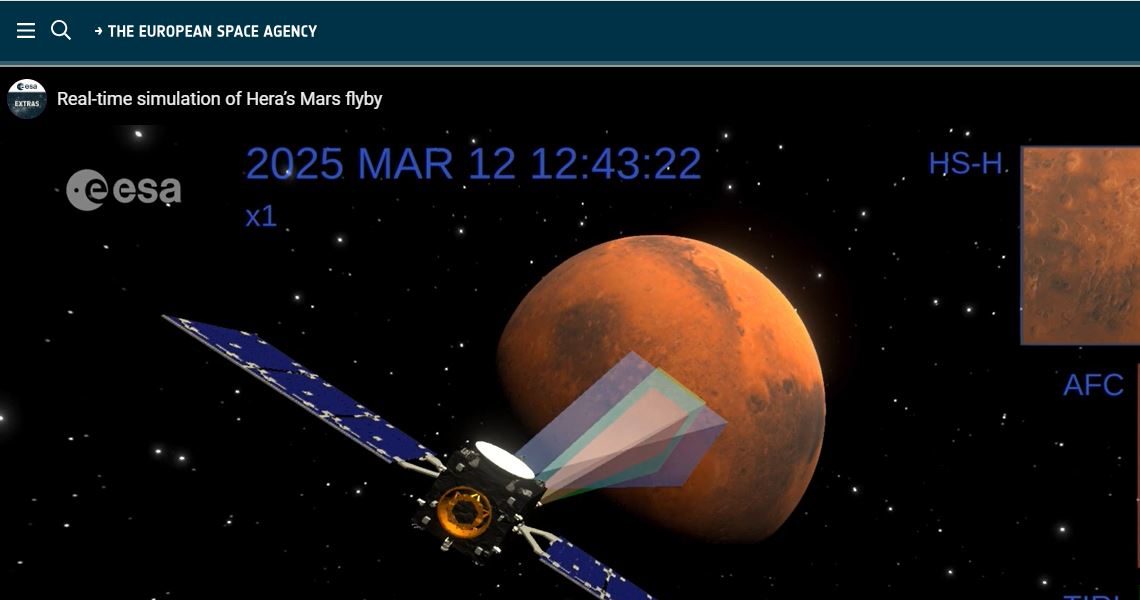
Hera will investigate the effects of the DART (Double Asteroid Redirection Test) experiment, the first targeted impact of a space probe on an asteroid. Piluca Caballo Perucha and Gerhard Paar from the Space Robotics and Instruments team at the DIGITAL Institute play a central role in data evaluation and processing, particularly in 2D and 3D analyses of the data recorded by the instruments on board Hera.
The influence of the DART mission
On 28th September 2022, NASA's DART probe collided with the asteroid moon Dimorphos in order to deliberately alter its orbit around the main star Didymos. With a diameter of 160 metres, it is large enough to destroy a city the size of Vienna in the event of an impact. Investigations after the DART impact showed that Dimorphos' orbital period was shortened by 33 minutes. ‘This proved that a kinetic impact can change the trajectory of an asteroid,’ said Piluca Caballo Perucha. Now Hera will investigate the long-term effects and provide detailed data on the asteroid's structure, composition and gravity.
The Hera mission in 2D and 3D
Piluca Caballo Perucha and Gerhard Paar from DIGITAL are making an important contribution to the Hera mission. In collaboration with VRVis, they are developing special software tools to analyse the collected data. These enable detailed 2D and 3D visualisation of the surface texture and material properties of Dimorphos and Didymos. ‘Our PRo3D GIS platform allows interactive exploration of the mission data and precise scientific analysis,’ explain the experts.
The end product of our work is the PRo3D-GIS tool for interactive visualisation and analysis of instrument data and its processing products in a spatially and temporally consistent context. PRo3D-GIS integrates the Hera instrument data into a database that contains all the data, metadata and derived products collected during the mission. This includes, for example, the position of Hera along its trajectory, the projection of sensor data onto the surface, and 3D models, some of which were created using DIGITAL software. Additional information layers include textures, slope maps, albedo maps, annotations, and multispectral maps," explains Gerhard Paar, who has been working with image processing software in the space sector and the planetary science it enables for more than 30 years.
This contribution to the Hera mission enables our space team to collaborate with the Hera team as a key partner in writing publications and participating in future ESA missions, including the Ramses mission to the asteroid Apophis. This asteroid has a diameter of 375 metres and will fly past Earth at a speed of 7.4 km/s at a distance of approximately 31,750 km on 13 April 2029. ‘The 3D GIS functionality and the necessary data interfaces expand our portfolio in Mars exploration and 3D tunnel mapping,’ explains Gerhard Paar.
A journey through the solar system
Hera was launched from Cape Canaveral on 7 October 2024 and is currently in the so-called cruise phase. On 12 March 2025, the swing-by manoeuvre at Mars was successful. The aim was to shorten the travel time to the asteroid Dimorphos. The probe was able to capture important areas of the Martian moon Deimos that had not previously been recorded in such detail. Gerhard Paar adds: "It remains to be seen whether this will enable us to refine the surface model of Deimos. The data will be incorporated into our tools over the next few weeks, both for tests in preparation for the approach to the Didymos system in 2026 and to support analyses of data from the Martian moon Phobos. At almost the same time, we also initiated images of the Martian atmosphere using the Mastcam and Mastcam-Z of the MSL and Mars 2020 Rover missions. This, together with the images from the Hera probe, could result in analyses of the Martian atmosphere that are very rarely possible in this form."
At the end of 2026, the Hera probe will reach its destination, the Didymos system, where two CubeSats – Milani and Juventas – will be deployed for complementary investigations. ‘The analysis of the crater structure on Dimorphos, which was created by the DART impact, is particularly exciting,’ says Piluca Caballo Perucha, who comes from Spain and joined JOANNEUM RESEARCH almost 25 years ago to work on her master's thesis in geodesy.
The final mission phase, involving a gradual approach to Dimorphos, will enable the project's scientific objectives to be achieved using PRo3D-GIS as the key platform for spatial acquisition and visualisation of a wide variety of instrument data. These include determining the gravitational field of Dimorphos, investigating its external and internal structure, which may have been altered by the DART impact, and analysing its physical, morphological, optical, thermal and chemical surface properties. In addition, the global composition will be mapped, the detailed properties of the asteroid crater will be measured, and further effects of the DART impact and the characterisation of dust clouds in the vicinity of the binary asteroid system will be investigated.
Looking into the future
The findings will be crucial for future planetary defence strategies. They also provide valuable insights into the nature of asteroids. This project marks a significant milestone in international space research and shows how modern technology can help protect Earth from potential threats from space.