© Joanneum Research
Detection of impairments and defects using computer vision methods has been increasingly adopted in recent years in different industry sectors, for example in media and manufacturing. This includes for example the detection of dust and scratches in film material, block and playback distortions due to data loss in digitised or digitally transmitted video, surface or structural impairments of manufactured products in RGB and hyperspectral images, and many more. Most deployed systems use highly sophisticated algorithms incorporating the specialised know-how of domain experts.
While deep-learning based approaches have brought significant progress in many computer vision applications, the specific nature of many defect detection tasks and the lack of training data (both due to the costs of creating datasets, but also due to the rare occurrence of many relevant types of defects) has hindered the adoption of these methods so far.
Making deep-learning based methods applicable to these defect detection tasks enables to adjusting them to specific types of defects occurring at specific users, as well as reduce development and maintenance costs in the long run.
The project is implemented together with our partner HS-ART-Digital.

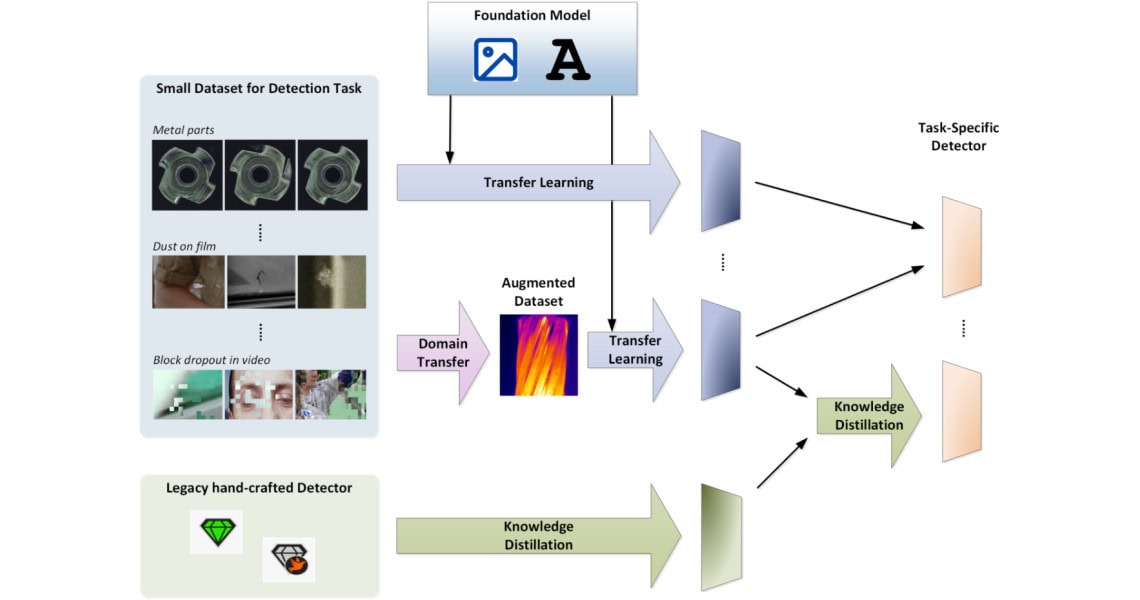
Defect.AI aims to research basic technologies for data-efficient training of visual defect detection methods. They will make use of recent advances in machine learning such as foundation models, which can be pre-trained in a self-supervised manner on large unannotated data sets and are then adjusted to a specific task using transfer learning.
Another important aspect is to capture the expert knowledge embedded in existing handcrafted detectors. Knowledge distillation will be used in order to learn this specific knowledge, which can be done at scale without requiring manual annotation. In order to bridge more significant domain gaps (domain adaptation), generative approaches such as GANs and diffusion models will be studied to perform e.g. style transfer between domains such as RGB and infrared.
The availability of deep-learning based defect detection approaches that can be adjusted to new variants of defects with small data sets opens a mid-term perspective of enabling users to adjust the models deployed on their systems efficiently.
Defect.AI aims to validate the approaches developed in the project in three use cases: quality control for manufacturing/industrial inspection, defect detection for film restoration and quality control for visual media digitisation.
HS-ART-Digital
JOANNEUM RESEARCH provides innovation and technology services in the field of applied research. As a research company working on behalf of various federal provinces and regions in Austria, our expertise shapes the development of our modern society and economy – sustainably, and always with a focus on people. As a multidisciplinary team working in a flexible set-up that fosters innovation, we always live up to the highest social and scientific standards.