


With the start of the new school year, the focus is once again on school routes – especially for younger children, as these often represent their first independent experience of mobility. However, a lack of infrastructure and safety concerns mean that many parents drive their children to school. This further exacerbates the traffic situation. In the FFG project ‘Auf vertrauten Wegen’ (On familiar paths), researchers from JOANNEUM RESEARCH, together with partners verkehrplus and stadtLABOR, are investigating how child-friendly infrastructure and targeted activities can bring about lasting change in mobility behaviour. Translated with DeepL.com (free version)
‘The journey to school is key to children's independent mobility. The more child-friendly the environment, the more likely children are to make this journey independently and actively,’ says Sebastian Seebauer, environmental psychologist and sustainability expert at LIFE, the Institute for Climate, Energy Systems and Society at JOANNEUM RESEARCH.
Survey and workshops at schools
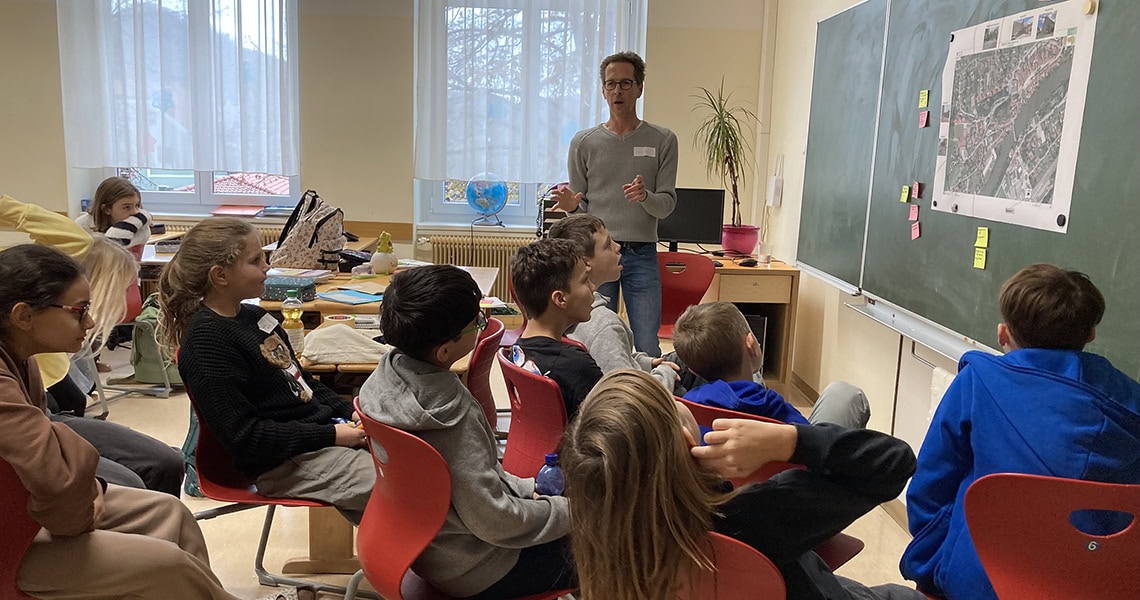
The researchers are tackling the issue head-on – in schools. At three primary schools and three secondary schools in Styria, pupils and their parents were involved in an initial round of surveys on mobility behaviour and perceptions of the journey to school. This was followed by twelve workshops with selected classes from the second to fifth grades. The children first contributed their views, ideas and needs. In a further step, concrete measures were developed with them, which are currently being implemented on site.
Hans Peter Ellmer, sociologist at LIFE, explains the participatory process: ‘The active involvement of children in shaping their school environment should encourage them to use public spaces independently, for example on foot or by bicycle.’
Younger children in particular find their journey to school more appealing and are more confident than their parents. The aim of the project is therefore to implement specific measures at all locations in the coming school year that enable active and independent mobility. These measures will then be evaluated to assess their impact on the mobility behaviour of children and parents (picking up and dropping off).
The figures from the previous year show that action is needed: according to Austria, 2,476 children under the age of 14 were injured in traffic accidents between January and September 2024, and four children died. In Styria alone, 72 schoolchildren were involved in accidents on their way to school in 2024.
More