

The EU project FAIRWork is bringing humans, AI and robots to the table – well, the production line. Instead of profit maximisation, the focus is firmly on employee well-being. A team from JOANNEUM RESEARCH’s DIGITAL Institute is using the latest technology from the Human Factors Laboratory to strike the necessary balance between efficiency and empathy.
Technology for people
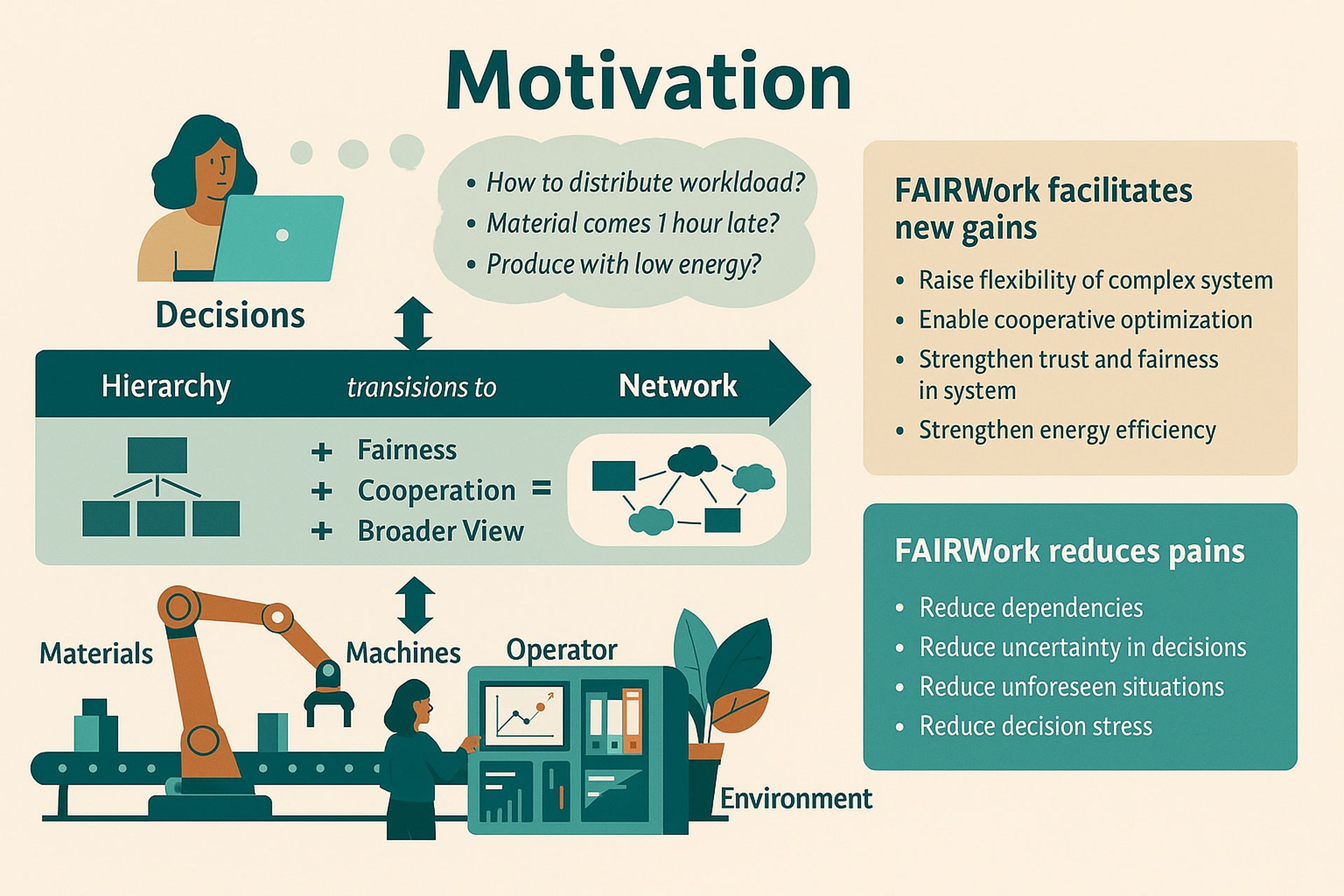
The EU’s Industry 5.0 initiative may sound a little like science fiction, but it is aimed at bringing about a very specific change: ensuring that technology is no longer geared solely to boosting efficiency, but to empowering workers, too. Rather than maximising profits, individual well-being is what counts, with top-down decision-making giving way to employee participation – with the support of artificial intelligence. This is where researchers on the European FAIRWork project (which is funded through the HORIZON EUROPE programme) come in. Coordinated by Vienna-based BOC Products & Services AG, the project has brought together numerous partners – including the JOANNEUM RESEARCH DIGITAL Institute, Stellantis, flex, and various European universities. The goal is to design decision-making processes that are more human-centric, democratic and trust-based – cultivating heart and soul in industry, you might say.
Workers under pressure
Demands on manufacturers are growing all the time – which also puts greater pressure on employees. According to Austria’s Federal Chamber of Labour, around 2.5 million days of sick leave taken in the country each year are due to mental health- and stress-related conditions. "Through the FAIRWork project, we’re addressing this development with specially designed technological solutions," explains Lucas Paletta, Head of the Human Factors Laboratory at DIGITAL. These include automated analysis of calibration certificates – previously performed manually, this process is both time-consuming and prone to errors. Now, though, a newly developed AI can identify missing or contradictory specifications in documentation, which saves time as well as enhancing accuracy. No longer left with mountains of data to trawl through, employees can focus on value-adding tasks instead. A more efficient approach – which also delivers peace of mind. Here, AI serves as an assistant for decision-making: it analyses complex production data, recognises Patterns and, on this basis, proposes possible courses of action that are tailored to a given situation – as well as clear and transparent for employees. Ultimately, though, the final decision is always taken by a human – because AI should support people, not replace them.
Delicate touch
Lucas Paletta and DIGITAL Senior Researcher Herwig Zeiner are making an important contribution to the project together with their team. Researchers at the Human Factors Laboratory use the latest Wearable technologies as well as biosignal trackers to investigate how stress and resilience can be measured within production environments. "We carry out objective analysis of the ways in which overwork occurs, as well as targeted measures that companies can take in order to increase employee resilience," says Paletta. "The aim is to create a working environment where Technology adapts to humans – and not the other way round." The researchers have developed procedures designed to make individual stressors more visible without any stigmatisation. The findings feed directly into a new AI model that can take such factors into account, for instance when it comes to assigning production tasks. All of which will make production smarter and also more worker-friendly in future.
by Elke Zenz
Learn more
- JOANNEUM RESEARCH DIGITAL
- Human Factors Laboratory
- FAIRWork
- BOC Products & Services AG
- Stellantis
- flex
This work has been supported by the FAIRWork project (www.fairwork-project.eu) and has been funded within the European Commission’s Horizon Europe Programme under contract number 101069499. This paper expresses the opinions of the authors and not necessarily those of the European Commission. The European Commission is not liable for any use that may be made of the information contained in this paper.