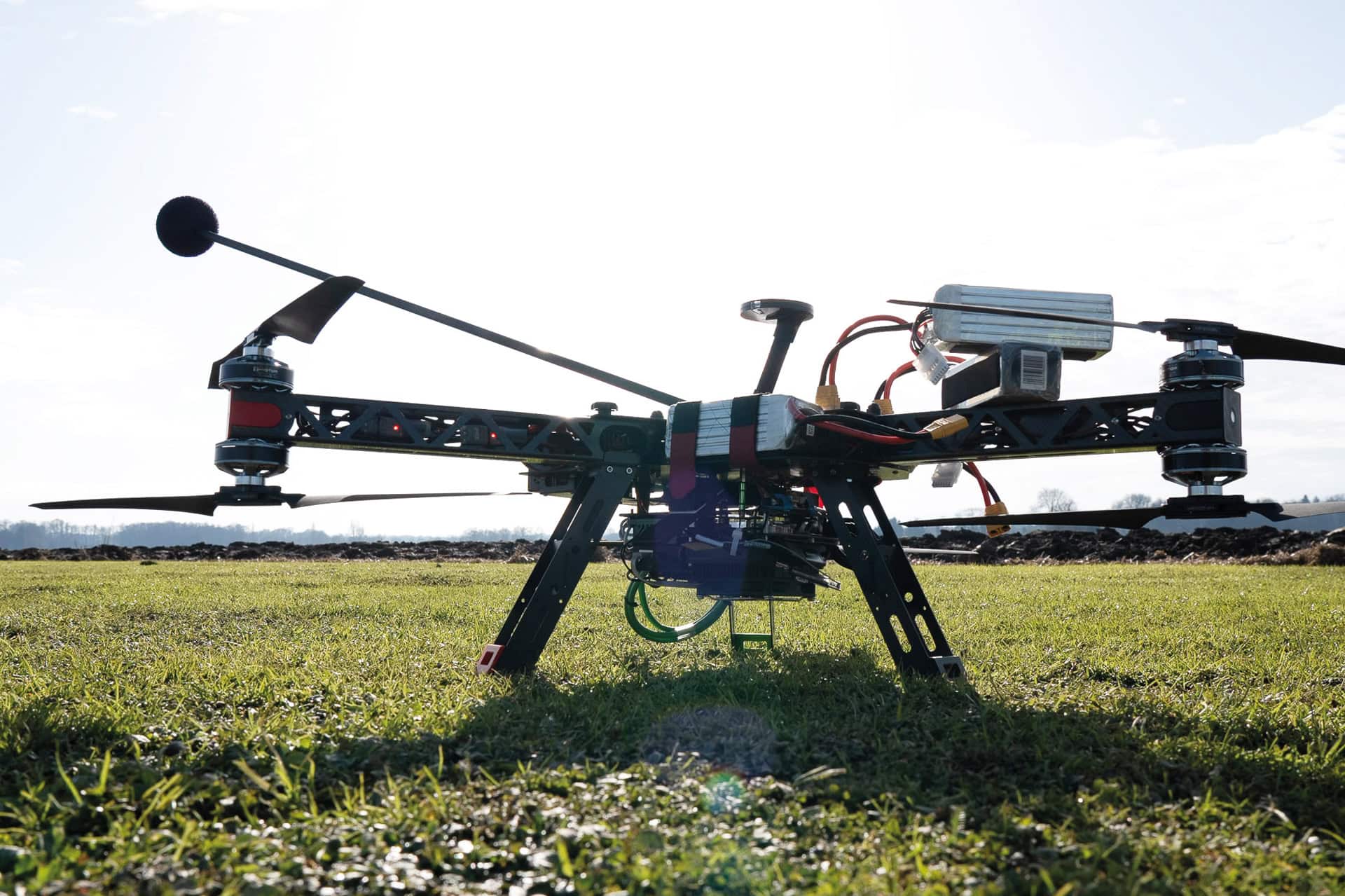



“Our acoustic drone detection enables us to identify unmanned aerial objects that are in the airspace without authorisation,” explains Martin Blass. Microphone arrays capture sound from various directions, and runtime differences between sensor signals pinpoint the sound’s origin. “It’s like listening intently in a specific direction while at the same time filtering out background noise,” Blass adds.
Drone detection: Listening in 3D
Mithilfe von Machine Learning wird das System kontinuierlich verbessert. Das Modell wird mit akustischen Daten von Drohnenflügen trainiert, um typische Geräuschmuster zuverlässig zu erkennen. „Je mehr Daten wir sammeln, desto präziser wird unsere Technologie“, so Blass weiter. Ein jüngster Durchbruch ist die Entwicklung eines 3D-Mikrofonarrays in Halbkugelform, das Drohnen präziser in der Höhe lokalisiert als herkömmliche 2D-Arrays. Dies ermöglicht eine präzisere Verfolgung von Drohnen in komplexen Umgebungen und verbessert die Identifikation von Flugobjekten erheblich. Im Vergleich zu herkömmlichen 2D-Arrays kann es Höhenwinkel besser erfassen und sogar mobil an Fahrzeugen genutzt werden. Die Einsatzmöglichkeiten sind vielfältig: Großveranstaltungen, politische Versammlungen oder Flughäfen können mit dieser Technologie vor unbefugten Drohnen geschützt werden.
Protection of critical infrastructure
It is particularly important to safeguard critical infrastructure, as drones weighing over 500 grams (that require a permit to fly in Austria) can cause significant damage. And in military applications, the system can be used to complement existing sensor networks for detecting aerial objects. Contrary to radar systems, which actively emit waves that make them detectable, acoustic detection operates passively – a major advantage in security-critical scenarios. A look at the future reveals a number of highly promising developments: planned research projects focus on distributed acoustic sensor nodes to extend detection range. Compact MEMS-based microphone arrays will operate directly where they are needed – “on the edge” – with minimal energy consumption, made increasingly efficient through advances in deep learning.
By Elke Zenz
More
- Research Group Intelligent Acoustic Solutions
- Business Area Security and Defence
- Security Research KIRAS
- Österreichisches Verteidigungsforschungsprogramm FORTE
The project is funded and financed as part of the FORTE programme and the KIRAS/K-PASS security research funding programme by the Federal Ministry of Finance and administered by the Austrian Research Promotion Agency.