

Rail infrastructure is a cornerstone of modern transport and supply systems. In light of increasing pressures and new threat scenarios, resilience measures are becoming increasingly important, ranging from safety and climate adaptation to intelligent monitoring. Experts working on the subject of railways and tracks at various levels – from geology and management to the technological background – provided interesting insights into their specialist fields on 16 April at the JOANNEUM RESEARCH headquarters. Forum Schiene focused on the implementation of digital, technical and organisational solutions for the future-oriented safeguarding and further development of the rail network.
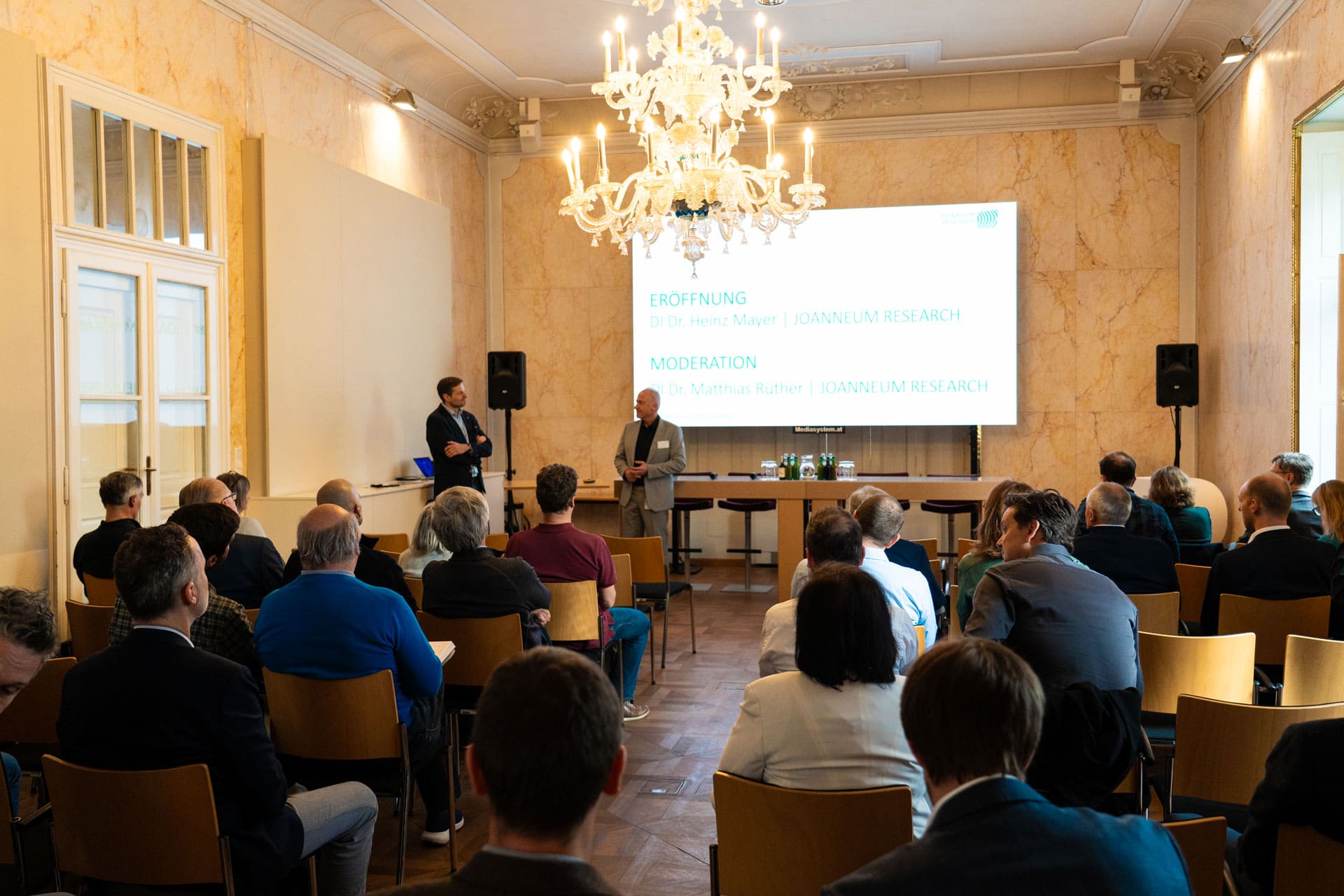
Following the opening address by Heinz Mayer, Managing Director of JOANNEUM RESEARCH, Matthias Rüther, Director of the DIGITAL Institute, hosted the evening.
Rail Forum: the presentations
Challenges in the road-rail system
“The increase in rail traffic, new rolling stock and rising loads pose major challenges for the rail infrastructure,” said Josef Fuchs of VIRTUAL VEHICLE. He presented a project involving statistical cross-comparisons and forecasts for the formation of so-called squats. Squats are cracks on the surface of rails that can lead to breakage. To this end, the rail network in Austria, Germany and Switzerland was scrutinised with regard to squat risk, and a risk management tool was developed. “The concept enables an international comparison of railway systems and identifies the most significant drivers of the risk of such damage occurring, which can be estimated using a simple formula,” said Fuchs. An interesting finding: the probability of squats occurring is significantly lower on the ÖBB rail network than in neighbouring Germany and Switzerland.
Staying on Track – An Examination of the Risks to Critical Railway Infrastructure from Geogenic Natural Hazards
Margit Kurka from JOANNEUM RESEARCH DIGITAL addressed the issue of geogenic natural hazards. Critical rail infrastructure is increasingly threatened by landslides and rockfalls, with climate change-induced extreme weather events acting as a key exacerbating factor. “These hazards are complex, often only partially understood and difficult to predict, as many causes and triggers interact,” said the geologist. Until now, a reactive approach to damage has prevailed; in the long term, however, a proactive approach focusing on prediction and prevention needs to be established: this includes technical protective measures such as structures, as well as systematic hazard mapping along railway lines. Monitoring and early warning systems are becoming increasingly important, for example through sensor technology, AI-based analysis and modern measurement methods. Large volumes of data, their analysis, and the communication of risks between experts, decision-makers and the public play a central role. The greatest challenge lies in managing uncertainties – yet at the same time, this very challenge opens up new opportunities for innovative, data-driven solutions in railway infrastructure protection.
Resilience management at ÖBB Infrastruktur AG – identify, prepare, respond
“Changing environmental conditions and new regulatory requirements demand greater focus on the resilience of the rail infrastructure in the face of a wide range of threats. ÖBB Infrastructure has responded to this by establishing a resilience management system,” says Jürgen Neuhuber of ÖBB. Resilience for the railway infrastructure means remaining capable of operating even during disruptions and adapting to changing conditions. Crises and disruptions are increasingly becoming the “new normal”, whilst legal requirements are rising. ÖBB’s resilience management is based on several key components: risk management, contingency planning, crisis management and physical protection. A central aspect of this is to consider a wide variety of risks collectively. In preparation for emergencies, critical processes are analysed and contingency plans developed to maintain operations as far as possible. In the event of a crisis, tiered response systems come into effect, supplemented by protective measures for infrastructure, staff and systems.
The resilience of the railways and the necessary research infrastructure
“Extreme weather events have so far been difficult to simulate or represent realistically,” says Ferdinand Pospischil of Graz University of Technology. “Nevertheless, in order to gain sound insights and develop suitable solutions, innovative research infrastructures are being established within the Graz University of Technology environment, enabling these developments to be investigated in a targeted manner.” The spectrum ranges from laboratory tests to measurements taken directly on the track. Pospischil provided insights into the vibration test rig, the wheelset shaft test hall, the brake test rig and the new track structure laboratory, which is due to come into operation this summer. Simulations, calculations and tests help to realistically model loads and develop solutions. By combining research and practical application, the railway can become safer, more robust and more efficient in the long term. Resilience thus becomes a key objective.
Presentation Ferdinand Pospischil
Resilience and examples of how to ensure it in the context of vehicle registration
Martin Joch from the engineering and testing services company PJ Messtechnik discussed the importance of the interaction between the pantograph and the overhead line for safe and stable rail operations. “To meet the high demands of daily operations, extensive tests and inspections are already carried out as part of the vehicle approval process,” said Joch. This interaction becomes particularly complex in multiple-unit trains, as several pantographs influence the overhead line simultaneously. Simulations make it possible to quickly analyse thousands of possible configurations and identify critical scenarios. In this process, both the pantograph and the overhead line are modelled as physical systems and coupled together. Real-world measurements are carried out for verification, during which forces, movements and other parameters are precisely recorded. The aim is to optimise the systems through the combination of simulation and measurement and to ensure a reliable electrical contact.
The ÖBB rail network in figures
- 1,060 stations and stops
- 7,000 trains a day
- 560 trains running simultaneously at peak times
- 18,990 employees
- 5,020 km rail network