

PRoVisG

PRoVisG - Planetary Robotics Vision Ground Processing
It is a Collaborative Project in the frame of FP7-SPACE -2007-1
Starting date:  Oct 1st, 2008  Project duration:  45 Months

The research leading to these results has received funding from the European Community's Seventh Framework Programme (FP7/2007-2013) under grant agreement n° 218814 "PRoVisG".

Content

What does PRoVisG want to achieve?

PRoVisG will build a unified European framework for Robotic Vision Ground Processing. State-of-art computer vision technology will be collected inside and outside Europe to better exploit the image data gathered during future robotic space missions to the Moon and the Planets. This will lead to a significant enhancement of the scientific, technologic and educational outcome of such missions.

Why is PRoVisG important for Europe?

At present, mainly the US have realized planetary space missions with essential robotics background. Europe needs to catch up with leading-edge technology and science. By joining institutions, companies and universities from different established groups in Europe and two relevant players from US, PRoVisG will demonstrate the European ability to realize high-level processing of robotic vision image products from the surface of planetary bodies. In such way Europe gains independence and reputation as a competitive partner for international research and exploration missions to the Planets.

How does PRoVisG benefit European citizens?

PRoVisG will address the public by means of a final robotic field test in representative terrain. The European tax payers will be able to monitor the imaging and vision processing in a Mars – similar environment, thus getting an insight into the complexity and methods of processing, the potential and decision making of scientific exploitation of such data and not least the elegancy and beauty of the resulting image products and their visualization. The educational aspect is addressed by a summer school, presenting robotic vision to the students who are future providers of European science and technology, inside and outside the space domain.

Media coverage

12.10.2011: Grazer Forscher testen Kameras für Marsmission (Salzburger Nachrichten, Gerald Stoiber)
20. 9. 2011: Mission ExoMars soll 2018 starten (Der Standard, Karin Kirchmayr)

Video - Final Meeting, 11th June 2012

Get the Flash Player to see this player.

 Associated Organizations

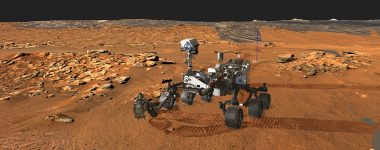
ExoMars Rover at CNES Mars Yard

PRINT / PDF

Ihre Ansprechperson


Partner

Aberystwyth University, Department of Computer Science
www.aber.ac.uk

Center for Machine Perception, Czech Technical University
cmp.felk.cvut.cz

Centre Suisse d'Electronique et de Microtechnique (CSEM), Zürich, Schweiz

CNES
www.cnes.fr

Department for Geodesy, Technical University Berlin
www.igg.tu-berlin.de

Department of Computer Science, University of Wales, Aberystwyth, Dr. Dave Barnes
www.aber.ac.uk

DLR Deutsches Zentrum für Luft- und Raumfahrt
www.dlr.de

EADS Astrium
www.astrium.eads.net

Joanneum Research Austria

Mapping and GIS Laboratory, Ohio State University
shoreline.eng.ohio-state.edu

SciSys Ltd.
www.scisys.co.uk

Surrey Space Centre, University of Surrey
www.ee.surrey.ac.uk

University of Bremen
www.marum.de

University of Nottingham
www.nottingham.ac.uk

Auftraggeber

EC FP7-SPACE
cordis.europa.eu